
When Your Dog Drives You Mad

Anastasia Antonova
Psychologist, CBT therapist

It’s normal to feel angry with your dog. They might not listen, damage something, or repeat a behavior you’ve been trying to work on for ages. At times like these, you may feel angry, irritated, or disappointed — and sometimes want to shout at your dog.
Imagine your dog has chewed up your brand-new, very expensive shoes. You look at them and think, “How could this happen? They were so expensive!” You feel angry and disappointed, and then you may feel the urge to shout.
But there are a few steps between what your dog did and how you react. In this article, we’ll look at how thoughts about what happened influence your emotions and behavior, why shouting doesn’t solve the problem, and what you can do when your feelings become overwhelming.
Why you feel like shouting
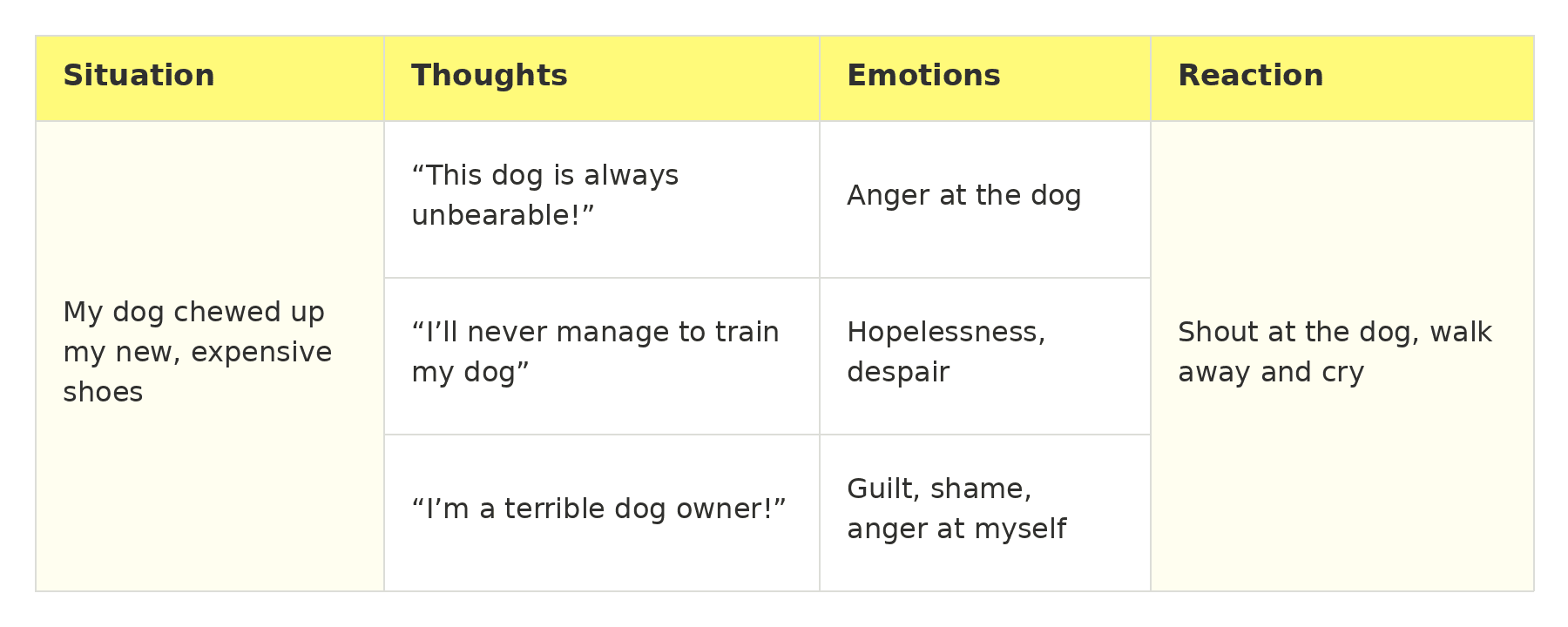
When your dog does something upsetting, thoughts and emotions come between the event itself and your reaction. In cognitive behavioral therapy, we can explore this using the sequence “event — thoughts — emotions — reaction.”
Let’s go back to the chewed-up shoes. The event itself is that your dog chewed them. Next come thoughts: “How could this happen? They were so expensive!” or “This dog is unbearable.” These thoughts bring up anger and disappointment, and one possible reaction is the urge to shout at your dog.
Working with your thoughts doesn’t mean replacing “My dog is driving me mad” with “What a wonderful dog I have!” If something is genuinely upsetting, anger is an understandable emotion. The aim is to notice the thoughts that come up in that moment and understand how they shape your reaction.
Why shouting doesn’t help
Once emotions arise, there are many ways we might react. Shouting at the dog is one of them.
But shouting doesn’t explain to your dog exactly what they did wrong. This is especially true if some time has passed: your dog will struggle to connect your shouting with the shoes they chewed a few hours ago.
Behavior that looks like “being naughty” may also be linked to stress, boredom, or other causes. Your dog isn’t chewing your shoes deliberately to make you angry. So shouting doesn’t address the cause of the behavior, but it may stress your dog out and leave you feeling guilty afterward.
Shouting at your dog, then, isn’t the most helpful response. But simply telling yourself “Don’t shout” usually isn’t enough. To change your reaction, you need to understand the thoughts and emotions that lead to it.
Exercise: understanding your reaction
Think back to the last time you wanted to shout at your dog. What was going through your mind?
If it feels as though you weren’t thinking about anything, try noticing what you think about that situation now. Thoughts can flash through our minds so quickly that we don’t always catch them.
Write those thoughts down. Then consider what emotions each one brings up and what reaction those thoughts and feelings might lead to. If the situation has already happened, recall what you actually did — that was your reaction.
You can use a table to make this easier:
How to work with your thoughts
Now you have a list of thoughts. Let’s work through them.
First, look out for generalizations such as “always” and “never.” For example, “My dog is behaving unbearably right now” and “My dog is always unbearable” are different thoughts.
Second, write down the evidence for and against each thought. Is everything really happening the way it feels in this moment?
Third, think about what you would say to a friend in the same situation.
Fourth, try to make the thought more specific. “My dog is unbearable” — what exactly are they doing? “I can’t cope” — with what, exactly, and how often?
Fifth, consider what you could say to yourself instead of the original thought. It doesn’t have to be positive — just more accurate and appropriate to the situation.
What to tell yourself instead
Let’s return to the thoughts from the previous exercise and try to come up with a more accurate response to each one.
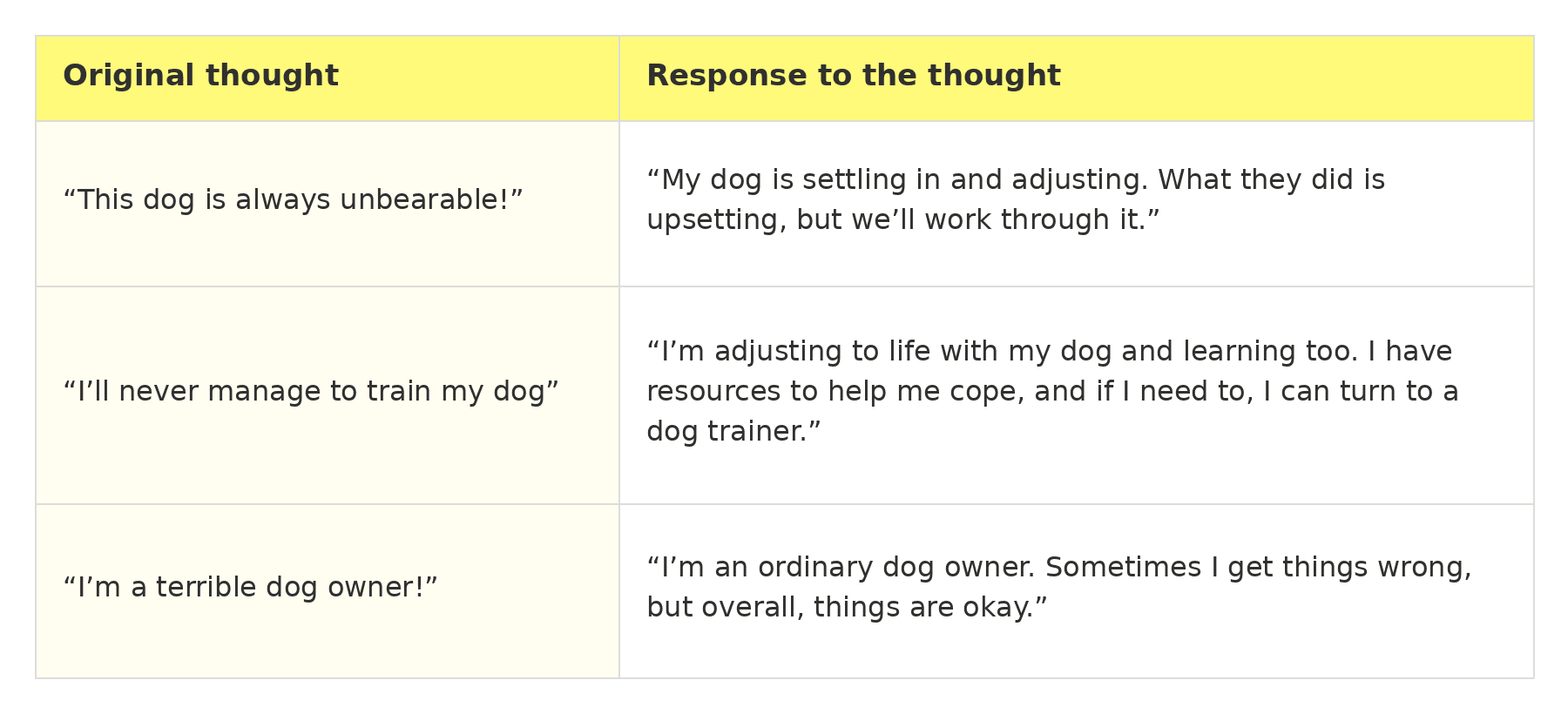
This isn’t about convincing yourself that nothing bad happened. The new response doesn’t have to be positive, but it should be more accurate and less absolute.
What to do when emotions feel overwhelming
Sometimes it’s hard to examine your thoughts in the moment because your emotions are already too strong. In that case, you can start by helping yourself calm down a little.
“I’m having the thought that…” Add these words before the thought that has taken hold of you. “I’m a terrible dog owner” and “I’m having the thought that I’m a terrible dog owner” sound different. This can help you take a small step back from your initial reaction.
Tense and release. When your emotions are becoming too intense and you feel you might do something you don’t want to do, tense your muscles — for example, clench your fists — and then relax them. You can repeat this a few times.
5-4-3-2-1. Find five things you can see, four things you can touch, three sounds you can hear, two smells, and one taste.
Breathe. Take a few deep breaths, or try box breathing.
Lie down! If you feel like shouting, try lying down — on your back or curled up on your side. Believe it or not, shouting while lying down is pretty awkward!
Sit! Try doing a few squats.
Sometimes we may feel angry with our dog or with ourselves. Sometimes we may even wish we hadn’t got a dog at all. And that’s normal.
We can’t always control the emotions that arise. But we can choose what we do next. You can feel angry with your dog — and still choose not to shout.