
What do tags on stray dogs mean?

Anna Platonova
Co-founder of Expaw

Many people assume that tags on stray dogs are just a sign that the dog has been caught, or even that it has a microchip. In reality, an ear tag usually means the dog is part of a TNR program (Trap–Neuter–Return).
Dogs with ear tags may also wear collars. This doesn't necessarily mean they have an owner. More often, it's a way for local residents or volunteers to show that someone is looking after the dog. In some cases, collars are added to prevent the dog from being taken for sterilization again.
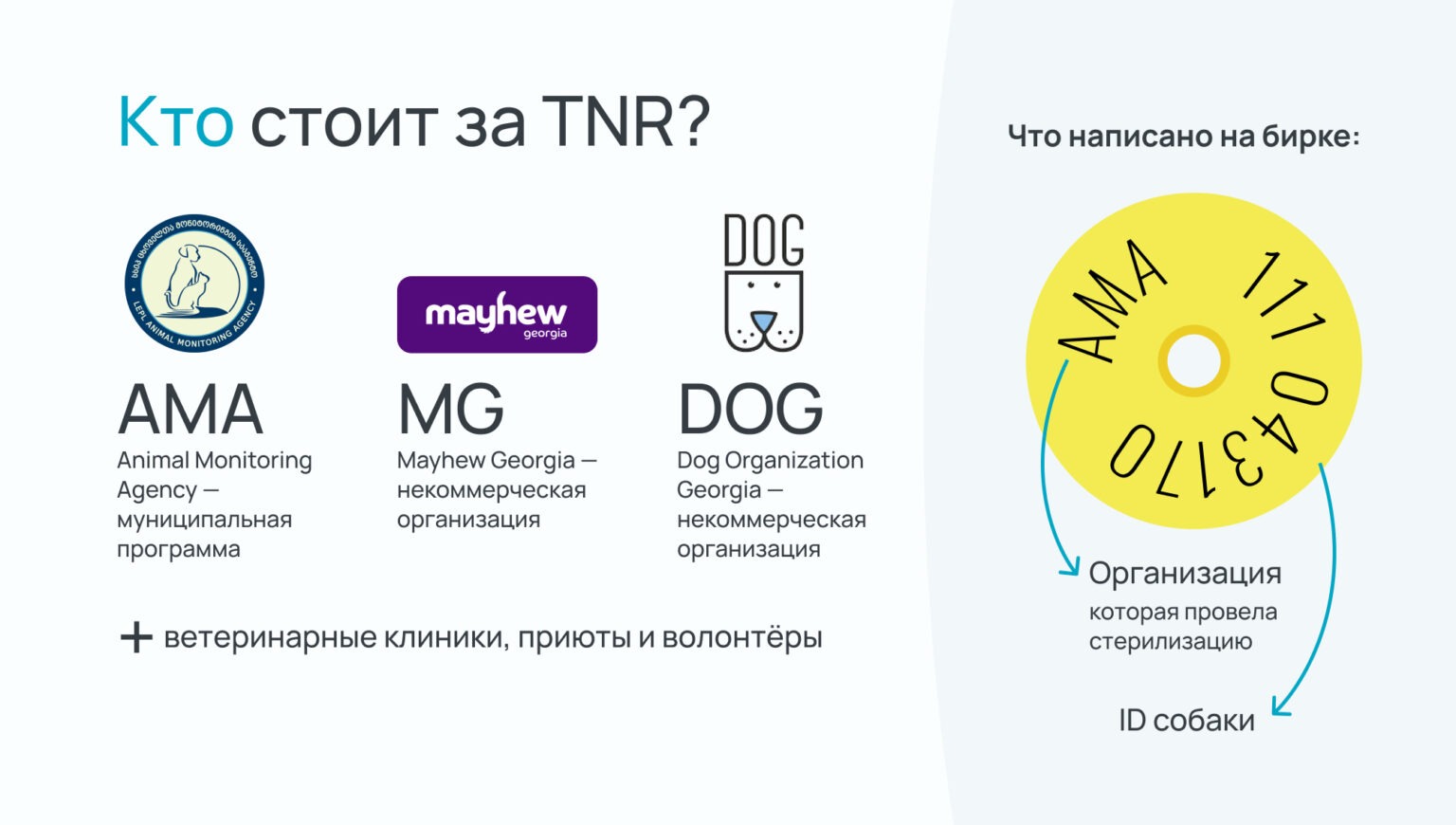
What is TNR and who runs it?
The TNR program has been operating in Georgia since 2015. Its goal is to humanely manage the stray animal population.
Here's how it works:
- the dog is safely captured;
- spayed or neutered and usually vaccinated against rabies;
- returned to its original territory.
Who is involved in the program:
- Animal Monitoring Agency (AMA) — the municipal authority;
- Mayhew Georgia (MG) — a non-profit organization;
- Dog Organization Georgia (DOG);
- veterinary clinics, shelters, and volunteers.
What does the tag say?
- the Georgian text «ფაუნის მონიტორინგის სააგენტო» (indicating the dog was sterilized by the municipal agency);
- abbreviations such as AMA, MG, or DOG;
- an individual ID number assigned to the dog.
An ear tag is not a microchip. All the information is visible directly on the tag. The color of the tag has no specific meaning — it's only used to differentiate batches and is not related to the dog's behavior.
What's important to know about ear tags on stray dogs
Rabies vaccination given during sterilization is not automatically renewed. In most cases, it's administered only once, during the initial capture. Follow-up vaccinations are rare and are usually done by volunteers. This means that even if a dog has an ear tag, its rabies protection may no longer be up to date.
An ear tag does not guarantee that the dog is fully healthy. Core vaccines for diseases like distemper or parvovirus are not part of the TNR program. Stray dogs can still carry and spread these infections.
You may also notice that some tagged dogs wear collars. This doesn't necessarily mean the dog has an owner. It may indicate that local residents or volunteers are looking after it. In some cases, the collar could be from earlier years when the dog had a home. If you're interested in such a dog, it's best to check with people nearby first.
How you can help without taking a dog home
Even if you're not ready to adopt a stray dog, there are still simple ways to make a real difference:
- Provide fresh water in hot weather, especially in areas without natural access.
- Create basic shelter during cold or rain — a box, a cover, or just a dry spot.
- Treat for parasites — spot-on treatments or collars can significantly improve the dog's comfort.
- Help with vaccination — if the dog was sterilized a long time ago, it's worth updating its rabies shot.
- If a dog is injured or sick and you have the means, it's better to take it to a private veterinary clinic. The Animal Monitoring Agency rarely responds to these cases.
- If a dog shows aggressive behavior, you can note the ear tag number and report it to the Animal Monitoring Agency: +995 (032) 2 421 424.
- If you're unsure what to do, ask locals or reach out to volunteer chats — in many neighborhoods there are people who look after specific dogs and can guide you.
"Most tagged dogs are friendly, well-socialized with both people and other animals, and can become great companions."
— Denis Simonov, Dog Trainer and Expaw Co-author
Key takeaways
- The color of the ear tag doesn't matter, but the ID number can help identify who carried out the procedure.
- Most tagged dogs are friendly.
- Vaccinations are not consistently updated, so it's important to stay cautious when interacting with stray dogs.
This article was prepared in collaboration with Denis Simonov, a dog trainer and animal behavior specialist.